Showing posts with label movie. Show all posts

Thursday, August 12, 2010

Scott Pilgrim T Shirt Giveaway - Come All Ye Dorkuses To The Chris Cab-tion Contest


I'm a huge fan of the Scott Pilgrim vs. The World comic book series written by Bryan Lee O'Malley (he's sort of Asian, much like myself). I was handed one on a recommendation from Berman Bothers himself, Loni Berman, and spent several of the next few subway rides rolling through each volume (they take about an hour to read through, very quick, like cheetah). Scott Pilgrim and his merry cohorts in their band Sex Bob-omb inhabit a hilarious, anime/gamer infused world that's a highly stylish, boy-dream setting for a charming and breezy romantic comedy. Mr. Pilgrim has the hots for Ramona Flowers, is being chased by Knives Chau, and is forced to fight Ramona's 7 evil ex-boyfriends (well one of them is well read it! Or watch the movie).

You have Michael Cera (not my first choice to play Scott) and all sorts of fun supporting cast members. What's great about the comic and hopefully what's great about the movie, which comes out tomorrow, is that even if you're not into the references and style, you understand the manic nature suits the story well and gives it a wacky bravado. I'm excited as any, and it's a great way to end the summer in my opinion. If it disappoints, I'll have to hadouken the theater usher.

In celebration of this film adaptation, I have two t-shirts to give away courtesy of Universal Pictures! You can see what they look like below. One is for guys (red). One is for girls (black). Both are size large. You want to go to there.

Guy Shirt: Red Scott Pilgrim T-shirt with full Scott Pilgrim logo on front and “An epic of epic epicness” tagline on back.
Girl Shirt: Black ladies t-shirt with lighting Bomb logo on the front and Scott Pilgrim logo on back nape of neck.

(I'll get pictures up tomorrow)

Now, for those of you who know our very own resident film critic, Roger Ebert's absolute favorite (from FilmCritic.com no less, featured on the homepage) Chris Cabin, you know he wishes he were Scott Pilgrim. Michael Cera too, but I'd rather be Chris Evans. He also owes me a beer from my birthday, so we'll as usual set him up with a Chris Cab-tion contest. You know the drill; comment to enter to win:

"I'll extinguish you"

For more, visit the pretty sweet official website. Or, just do like I do and play Scott Pilgrim Punchout until your head explodes. Basically there's a ton of cool things to check out and I would expect nothing less from an Edgar Wright directed film.

I'll consider all entries through Monday August 16th. Maybe a day after. Who knows?

Thursday, July 8, 2010

Brooklyn's Finest DVD Giveaway - Another Chris Cabtion


Our resident film critic Chris Cabin probably frowns on Brooklyn's Finest. Then again, he don't live in Brooklyn, so he don't know squat.

Anywho, since this is Brooklyn based blog, I'm giving away one (1) copy of Brooklyn's Finest on DVD, standard, because we're old school. The movie concerns the 65th precinct of Brooklyn and follows 3 police officers in the usual Antoine Fuqua fashion. Now, the 65th precinct does not exist anymore in real Brooklyn, but there is a reference to it in the 73rd precinct which is located in Brownsville, which is fittingly the kind of Brooklyn that a lot of people think about when they think Brooklyn.

Anywho, it's got a killer cast (Wesley Snipes hasn't been in a theatrically released movie since WHEN) and I was just next to Lili Taylor on the train the other week. I also remember when Ethan Hawke was all over the projectionist union dispute at IFC Center when we first opened. I've never met Richard Gere, but if he has anything against the Chinese after Red Corner, I probably should stay away, no?

Here's the theatrical trailer:


We have our resident film critic Chris Cabin once again the subject of a caption contest, all you have to do is comment below for a chance to win the DVD. It doesn't even have to be that funny. Because Chris Cabin's film reviews are far from funny. Look at this picture and give it your best shot:

Yes, you can also purchase this shirt. Captions after Sunday will not be considered. For more on Brooklyn's Finest, check out their Facebook and Twitter pages.

Friday, December 18, 2009

Resident Film Critic Chris Cabin Reviews: Avatar (One of those beneficiaries of 3-D)


Our very own resident film critic, Chris Cabin, of AMC's Filmcritic.com, gives his take on a whole planet full of Blue Man Group. As always, his opinions are his own and not necessarily reflective of the KCB, but I know I'll probably think this movie is gonna score a win in my book.

In his new film Avatar, James Cameron sets upon doing something monumental and, one would think, overwhelmingly tedious: Creating a new world. Which is to say where so many "massive" filmmakers have developed alternate realities or adapted the strange wilderness of lands found in literature, Cameron has both envisioned an entirely original ecosystem of flora and fauna, and given new emphasis to what it means to its inhabitants. Trees grow incandescent lines of communication to the dead and may house entire civilizations if let be. Appendages connect and bind through small hairs, allowing all manner of animal -- whether web-winged or heavy of hoof -- to download the moral and spiritual compass of one another. Everything is connected and everything burns radiant, even in the daytime.

Gestating in the day-glo terrarium of Cameron's frontal lobe for something like fifteen years, Avatar is the most enveloping and (no two ways about it) beautiful spectacle to find home at the multiplex since Peter Jackson's stroll to Mordor, and clocks in, thankfully, in only a third of the runtime. And like the warring tribes at its center, it is a film of two worlds with its seamless, brilliantly colorful mix of digital animation and live-action colliding, clashing and finally flowing with the power and thrill of a raging river. Giving newfound cred to the motion-capture technique so absurdly misspent trying to make human beings look just slightly less human in The Polar Express and A Christmas Carol, Cameron's alien western likewise lends defense to that other over-used marketing tool: 3D not only gives the imagery lift but highlights the depth of Cameron's worlds, evident from an opening shot of soldiers, scientists and missionaries floating upwards out of rows of sleep cells.

Set-up as a last-ditch replacement for his twin brother, Jake (Sam Worthington of Terminator: Salvation) pauses to glimpse at two floating pebbles of water before he is ejected into the same weightless space. His destination is Pandora, Cameron's ostensibly peaceful planet ruled by the Na'vi, a species of 10-foot-tall blue-monkey cat-people who ride reptilian horses with ant-eater noses. Crippled while serving in the Marines, Pandora offers Jake a working body in the form of one of the blue-monkey cat-people -- an avatar. His payment is the surgery to reconstruct his own dilapidated form. Jake works under a chain-smoking, green-as-can-be scientist (Sigourney Weaver) and chums it up with an eco-dweeb (Joel Moore) and later reports his findings to tough-as-coffin-nails Colonel Quaritch (Stephen Lang of The Men Who Stare at Goats) and a Fortune-500 architect of doom (Giovanni Ribisi, one-upping Paul Reiser's greedy brat from Aliens).

Saved by warrior princess Neytiri (Zoe Saldana), the conflicted marine now finds himself a prophet-in-training to the warrior princess's father (Wes Studi) and her psychic earth-mother (CCH Pounder) and in rivalry with her betrothed (Laz Alonso). Streaming intel back to the Colonel, Jake is too busy learning to ride oversized neon-orange pterodactyls and tenderly mating with Neyteri -- the film's cheesiest moment -- to realize that the military and the corporate goons are planning to decimate Pandora in the hopes of mining it for a valuable mineral known as Unobtainium. Climactic war is waged with Jake and his pack of eco-friends backing the Na'vi and the brutish troops sporting their own types of avatars -- heavily-armed supped-up robo-bodies upgraded from Ripley's alien-fighting cargo-mover.

Replete with soggy allegories to every racial conflict in human history, though Native Americans are given the most blatant treatment, Avatar is essentially a film about the progress of film technology in a similar way that Quentin Tarantino's Inglorious Basterds confronted how we see the past through film. Cameron has conceptualized the act of motion-capture on-screen and given it immense visual muscle, making the Na'vi tribes not only the trippiest civil-rights advocates of the decade but the first convincing case of visual effects as a sincere conductor of human emotion not to involve the name Pixar. The humans are portrayed, primarily, as unreasonable creatures driven only by a selfish agenda and who see the Na'vi as nothing but a paltry nuisance; an opinion similar if not identical to cinematic purists who dismiss the advancement of technology as a threat to "real" filmmaking.

Of course, Avatar borrows heavily from cinema's past through a bevy of American westerns and, just maybe, the nature-themed animation of Hayao Miyazaki; the story is most obviously contrived from Kevin Costner's ludicrous Dances with Wolves. But even as Cameron uses these genre stereotypes and benchmarks to root viewers among the ruby-red mushrooms and dragon hounds, the director uses Avatar to cannibalize his own oeuvre: Elements from Titanic, The Abyss, True Lies and, most prominently, Aliens are redeployed under the canopy of his new technological frontier. It would be easy to cast off Avatar as a leftist parable aimed towards reckless red-staters but sweet love for mother earth is far from Papa Cameron's endgame. Assured and confident in his status as the preeminent living director of the motion-picture spectacle, Cameron's latest offers an olive branch between those who think that cinema is dead and those who think it's just rediscovering its own form.

Editor's Note (who am I kidding): Avatar made 73 million at the box office this past weekend. I went in the snowstorm to Astoria to watch in 3-D. While not without it's faults, namely being the cheesiest Cameron movie in certain parts, it is overall a fantastic adventure film with a universally appealing and uplifting message.


Tuesday, October 20, 2009

Unnecessary: Boondock Saints II Trailer

The Boondock Saints is a horrible movie. In fact, personally, it's one of my top 5 least favorite movies of all time, up there with such luminaries as Empire Records and Love Actually. I've actually been punched for voicing such an opinion of The Boondock Saints' first go around, and after I saw Overnight, the documentary about the writer and director Troy Duffy, and realized how much of a ridiculous person he is, it only strengthened my resolve.

The first film not only had a terrible plot, poor character development, crappy action sequences, and an awful "commentary" ending, but there are so many "Boston" movies such as Gone Baby Gone and Monument Ave. that are just so much better. Granted, this is an action movie in the John-Woo-rip-off mode and thus can be held to different standards as those dramas, but I don't find anything in this movie to recommend. It's a sociopathic film that has no reflection on the characters portrayed; Willem Dafoe's tranny FBI agent is such a retardation and Billy Connolly's Il Duce doesn't seem to have much of a purpose. Forget the Irish theme supposedly drawn up by the fact that the two leads are Irish Catholic vigilantes who society is sort of led to believe that they are doing good. Sure, they are getting rid of the baddies. But the action scenes are just awful I think; they are overcomplicated, and the slow motion has no beauty to it; and the staging is abhorrent because there is actually very little grit to it. Duffy is trying to make something shallow and stylish out of something that should be more brutal and less fanciful. Maybe it would come off more interesting if he actually cared about his two lead characters, Irish brothers who think they are on some mission from God. That character motivation alone is just kinda nuts but in Duffy's hands is all the more frustrating for the caricatures he creates. There is something freaky about how they kill for God, but Duffy doesn't do anything with it. He just goes along which makes me think that he's just some religious nutjob making a movie about religious nutjobs.

So quoting the Bible is cool? Yes when Jules does it in Pulp Fiction, because at the end it becomes a key character beat for him.

Two guns and slow motion? Yes when John Woo does it.

Hanging from the ceiling by a wire? Yes when Brian De Palma does it in Mission: Impossible (even though that movie kinda sucked too).

Violence and religion? Yes when it was called Mean Streets or State of Grace. Or The Apostle if you include baseball bats.

Oh and the second one is coming out at the end of the month. Seeing Duffy's face intro the trailer on the Rotten Tomatoes version makes me want to smash my computer screen. He's so smug. The fact that Peter Fonda is in this just screams "I did it for the money." And the fact that Judd Nelson is in it, well that's just a neutral addition.


Friday, September 18, 2009

Resident Film Critic Chris Cabin Reviews -


Note: The Informant! is playing at most theaters in the city and in Brooklyn, go here for showtimes. Poster courtesy of IMP awards.

As has been widely reported, Matt Damon gained 40 pounds to play whistleblower Mark Whitacre, the mustachioed high-level exec at Archer Daniels Midland who became an informant for the FBI sometime in late 1992, in Steven Soderbergh's odd new film The Informant! Hidden behind a pair of thick frames, adjusting his toupee as much as his mood, Damon's Whitacre is plain, greedy and fantastical; the sort of man who sees himself not only as a corporate hero in any one Michael Crichton novel but also reflected in the Tom Cruise who embodies those righteous corporate ethicists on the big screen. He has ideas and big plans, ones that he believes could be jeopardized at any moment by a random tapped phone.


And yet, he is, as several people involved with the real Whitacre have opined, a sort of national hero. A biochemist who had to "learn business," Whitacre supplied hundreds of tapes -- audio and visual -- to the FBI between 1992 and 1995 that fueled the Justice Department's case against ADM leading to the agribusiness conglomerate paying well over $500 million in settlement and class action cases. The catch, of course, was that while playing avenger, Mr. Whitacre forgot to disclose kickback funds that may have reached more than $11 million. Faithful to his wife of 20+ years, the father of two adopted children and one of his own, he is a liar and a thief but it would seem, in Mr. Soderbergh and screenwriter Scott Z. Burns' eyes, that every good corporate man has an accepted level of corruption going in; even the ones who want to clean up the joint.

Scored by Marvin Hamlisch in what, at first, seems like a bid at kitsch, Damon's guileful do-gooder opens the film by explaining, both to the audience and his child, how corn is in everything you eat, touch and steal. At ADM, his work has largely focused on lysine, the amino acid that his company frames their price-fixing scam around. It's his wife Ginger, dutifully played by Melanie Lynskey, who prods him into confessing the price-fixing scam to Special Agents Shepard (Scott Bakula) and Herndon (Tony McHale). Professional if just a bit zealous, the Agents sum up Whitacre as both brave and boring. In a brilliant bit of screenwriting, the action and dialogue are repeatedly overshadowed by Whitacre's voice-overs, delivering monologues on an array of throwaway facts including polar bears, being kind and tie sales in whispery chatter reminiscent of Godard's hovering prognostications from his 60s salad days.


An extension of these monologues, Soderbergh's aesthetic is a marvel of bourgeois bad taste. Made with the washed-out precision of cheap 80s television, editor Stephen Mirrione and production designer Doug J. Meerdink work with director/cinematographer Soderbergh to invoke the nausea of upper-class lethargy. But despite this bravura tribute to mediocrity, The Informant! Is not a sweet movie nor is it a placid one. Whitacre embodies the mindset of the current business construct: I'll open the closets as long as you don't stare at my skeletons.

Softened ever-so-slightly by the admittance of bi-polar disorder, Whitacre's infuriating inability to own up to his own malfeasance may not have been sold so easily if not for Mr. Damon who has rarely been so clever and never been as funny as he is here. Seeing as he is constantly surrounded by a rogue's gallery of lawyers and co-workers, Soderbergh pulls a masterstroke by casting many of the smaller roles with stand-up comedians and television actors -- Patton Oswald, Tom Wilson and Tony Hale all show up in minor roles. It plays directly towards Soderbergh's central premise: The characters primarily responsible for our current crisis are so off-the-chart self-serving, greedy and absurd, that you really have no choice but to laugh at them.


Even as it points to our current state, The Informant! also contemplates the grand lunacy of how we pick our heroes. Is Whitacre to be admonished or celebrated? Despite his presumptuous greed, he helped bring in one of the great monopoly schemes in history and remains, to this day, a good father and husband. As we begin to heal from the bruises of the Bush era and weather the outlandish accusations made against honest reform, The Informant! speaks to a generation where the concept of honesty has an 80% mark-up.

Chris Cabin is the resident film critic. You can catch him at AMC's Filmcritic.com. Or win a pair of Yo La Tengo tickets to their Roseland Ballroom show next week by commenting on his recent Cab-tion contest.

Monday, August 3, 2009

Resident Film Critic Chris Cabin Reviews - Judd Apatown's Funny People

The opening of Judd Apatow's third film Funny People sees Adam Sandler when he was still young, making a prank phone call to a local deli. It was shot by Mr. Apatow while Sandler and he were living together in LA and though it is a real video that pre-dates Sandler's salad days on SNL, it is also meant to be a video tape of George Simmons, the absurdly wealthy comedy kingpin Mr. Sandler plays in Apatow's latest two-hour-plus comedy.

Unlike the protagonist of Apatow's last two films, it is not maturity that is weighing on George but rather mortality; though, it could be argued that the latter informed the hesitancy towards the former. George has recently been diagnosed with a rare form of leukemia and has taken on an experimental regiment to attempt to beat it. A box-office tyrant, George has starred in such films as Merman, My Best Friend is a Robot and Re-Do, in which a wizard turns him into a baby with the brain and face of an adult; he shows nothing but disdain for all his films as he contemplates oblivion.

George exists in a dream world where comedians are so rich they don't even have to bother with being funny. Ira (Seth Rogen) has just begun a hopeful ascent to such a world. After working days at a deli counter, Ira goes home and writes stand-up material with roommates Leo (the invaluable Jonah Hill) and Mark (Jason Schwartzman) that he hopefully gets to peddle at the legendary Comedy & Magic Club in Hermosa Beach.

Here, Apatow sets up an immediately intriguing dynamic. Mark acts in a cheesy sitcom called Yo Teach! and makes more money in a week than Ira makes in a year; Leo gets more notoriety at the clubs and is a more popular performer in general. Apatow never attempt to justify why Leo and Mark are more successful than Ira past the fact that Mark knows how to sell himself and Leo is, quite simply, funnier than him at this specific interval. It gives both Ira and his struggles (on and off-stage) more definition.

After a grimly narcissistic set at the club, George asks both Ira and Leo to come write jokes for him. Feeling he's owed one, Ira takes the job for himself and neither Rogen nor Apatow slink away from the cordial backstabbing that many Hollywood careers are based on. Soon enough, Ira is writing for George and becoming his sole confidant, pressuring him to make peace with family, friends and colleagues before it's too late. "I think I played it all wrong" says George before he is informed by his Swedish doctor (Torsten Voges) that the leukemia has apparently been cleared from his system.

Life as he knew it can now continue but, after seeing death, George wants a crack at the normal life. This is where Laura (Leslie Mann, the off-screen Mrs. Apatow) comes in with her high-pitched voice and waves of dirty-blonde hair; "the one who got away" as George puts it. Now married to an Australian businessman (Eric Bana) with two kids (played by Apatow and Mann's daughters, Iris and Maude), Laura divulged that she still was in love with George when she found out he was dying. His rebirth seems the perfect platform for them to reunite, with Ira playing chaperone.

Like any celebrity, George wants for a normal life but never stops to think if he's capable of one. For him, death was his one brutal glance at the one thing that all humans, private jet or not, have to face eventually. He regresses in character to who he was before fame but when it comes surging back into his bloodstream, he can't ignore his given nature. Ira cries when Laura puts on a tape of her daughter singing "Memory" from the Broadway show CATS but all George can do is look at updates for a possible sequel to Re-Do and remark how his druggie friends might get a kick out of the "Memory performance. He is an entertainer and cannot help but see the funny side of things; he is not programmed naturally for compassion. The populous is the only thing he could ever commit to.

Apatow's apparent touchstone here is the early work of James L. Brooks, especially the excellent Broadcast News. Similarly, that film dealt with the moral highs-and-lows of modern television; entertainment versus insight and information. Funny People is less biting than that film but the interplay is similar. The way Holly Hunter softens her blow when William Hurt brings her a human interest story mirrors Rogen's hesitation to let George really have it when he realizes he's breaking up Laura's marriage. There's also the communal nature of the comedy world that gives the film a very distinct flavor of insider drama; Paul Reiser, Sarah Silverman, Eminem and Ray Romano all make great cameos.

Apatow softens his blow at the very end but I found myself overwhelmed by the ambition and overall craftsmanship of Funny People. Even the transitions seemed less bumpy after a second viewing. Sandler is playing a fascinating version of himself here and part of the pull of the film is considering just how much of George is Sandler. And despite the fact that Rogen's character is prominent throughout, there is no question that this is George's film, deeply affected by the throws of humor and fame. Early on in the film, George refers to humor as a necessary defense he developed to please and quell his father and at the heart of Apatow's film is the question of rehabilitation even from the most basic parts of our character. In the end, George finds a healthy way to channel his need for laughs with Ira but the bug is still there and it seems clear that it always will be.

Chris Cabin is THE resident film critic and his opinions do not necessarily reflect those of the Kings County Bop. You can find his reviews at AMC's Filmcritic.com as well as linked from Rotten Tomatoes, complete with several comments, none about his facial hair.

Tuesday, June 30, 2009

Resident Film Critic Movie Review On: Bye Bye Blackbird - Michael Mann's Public Enemies


Michael Mann's Public Enemies is an honest depiction of a life that could only be true in film. John Dillinger is played by Johnny Depp, another public figure whose inner life is ostensibly unknowable, and his foil, the budding G-man Melvin Purvis, is played by Christian Bale. As Depp plays him, he is a romantic, disciplined figure of the public's mythic conscience; Robin Hood in a three-piece suit with a Tommy gun at his side. Above him, around him and to him, Mann emphasizes not only the birth of organized, capitalist-driven crime but the sheer thrill of being romanced by such a public figure.


At a drab Midwest prison circa 1933, Mann begins with a breathless prison break orchestrated by Dillinger and compatriot John "Red" Hamilton (Jason Clarke) to release the bulk of their Chicago gang, which included mentor Harry Pierpont (David Wenham) and Homer Van Peter (Stephen Dorff). His return to Chicago is marked by a robbery and a meeting with his counterpart Alvin Karpis (Giovanni Ribisi) but is sent into overdrive by the appearance of sassy coat-check girl Billie Frechette, played by the excellent Marion Cotillard. They fall madly in love and stay together even as he is sent to prison again and narrowly escapes capture until his infamous death in front of the Biograph Theater in Chicago in June 1934.


Public Enemies is set during the depression but nothing on the screen suggests the depleted environs, save for the public's love for the concept of simply taking the government's money whenever they please. Mann's film is not a chronicle of American history as much as it is a chronicle of a pivotal point in America's love for crime and their need to know that a life of crime is always possible and that it does indeed pay. A recent New York Times article recounted the production of Public Enemies, which began as a film about Jewish mastermind Karpis, as a hope of chronicling the half-decade or so when Dillinger, Bonnie and Clyde, Ma Barker and Baby Face Nelson were celebrities of high prestige, hidden in plain sight.


In Mann's film, Nelson is played by the great British character actor Stephen Graham, a force to be reckoned with in Shane Meadows' This is England. He is, along with Karpis and Dillinger, the reason that J. Edgar Hoover (Billy Crudup in fine form) is seeking to turn his Bureau of Investigation into a Federal body, with Purvis as his lead G-man. As fatalistic as the man he chases, Purvis is introduced as he guns down Pretty Boy Floyd (a brief Channing Tatum) in an orchard and exits as the smallest cog in Dillinger's death. Betrayed by father figure Hoover when he is asked to "take off the white gloves," Purvis is, as the film consistently points out, just as disillusioned with the embryonic FBI as Dillinger is with the initial steps of the Chicago mafia's clandestine agreements with law enforcement to cut the chord with Dillinger and his lot.

As with his last film, the nocturnal free-flow Miami Vice, Public Enemies at once works to concrete Mann's immense talents while further pointing out his minor but telling weaknesses. Soundtracked mainly by Mort Dixon's "Bye Bye Blackbird" and other depression-era lullabies, there is still that indulgence in steely electric guitars to emphasize action and pace, less prominent and much preferred over the swells of Audioslave that dogged both Miami Vice and Collateral.


Like The Dark Knight, Enemies is an unlikely summer entry; one that must accept certain conventions to ensure its box office yet consistently upends and reevaluates the very parts of its DNA that make it a hopeful box office titan. Paced smartly and fitted with solid ensemble performers, which also includes the stage actor Stephen Lang and Rory Cochrane as Purvis' partners, Public Enemies enlists digital cinematography in the most provocative commercial form to date, adding looseness and clarity to a genre usually noted for its tight framing. Wielded by Mann's staple lenser, the crafty and deft Dante Spinotti, Mann's camera peers into the film's nighttime siege of Nelson and Dillinger's woodland hideout with an uncanny ease and thrilling precision; the film's aesthetic feels as if it's on the lam along with its central figure.

Depp's performance, calibrated and deployed with a leopard-like charm, doesn't outshine Bale nor does it work to tower above prominent screen partner Cotillard. Mann has always been an expert at harmonious acting: You may remember the scene between Pacino and DeNiro in Heat but it is not the film's most memorable scene. The film, written by Irish scribe Ronan Bennett along with Mann and Southland creator Ann Biderman, is based on Bryan Burrough's astute study of the crime waves prominent in the early 1930s and the subsequent birth of Hoover's FBI; the film's relation to movement and the chase rather than the national reflection speaks to the gone-tomorrow mentality of the era more than the vision of a thousand breadlines. Like its two lead characters, Public Enemies has certain nostalgia for the flash of early crime, the simplicity of it; it has an open distaste for procedure and concentrates on the swiftness and cunning of these jailhouse playboys. Obviously relating to Dillinger and Purvis, Mann chooses innovation over security, a Tommy gun over a ledger.


Chris Cabin is our very own resident film critic. You can find other reviews at AMC's Filmcritic.com. His opinions are not necessarily those of The KCB.
The KCB: Here is a featurette on the crew and staging of a bank robbery in the film; it echoes all of Michael Mann's crime film work, he loves the idea of a crew:

Tuesday, March 24, 2009

Lunchtime Justice: Rumble In The Bronx - New York Justice? I think SO!!!!!

Well really it's Vancouver Justice. But whatever. The Chan-ster kicks some kei-ster circa 1995 in his first American film. Complete with English subtitles because well...just 'cuz.

Featuring the late Anita Mui.

Wednesday, March 18, 2009

What Would NYC Be Like Without The Subway?


After reading the NY Times article linked to from Brownstoner regarding Gov. Paterson's decisive rejection of another save-MTA plan, I thought how dystopian would it be if we didn't have the subways. The whole debacle on the A train in Brooklyn from Jay St. to Euclid including some weird shuttle bussing and lots of yelling got me thinking too. Walking and biking would of course increase but it'd be a pretty interesting character study fodder for a movie eh? Like Do The Right Thing, but instead it'll be called "Insufficient Fare" or something...

Thursday, March 12, 2009

Lunchtime Justice: Out For Justice - New York Justice? I think SO!!!

Steven Seagal is outshined by William Forsythe in this riveting moment from Sunset Park, my old neighborhood (at least it looks like under the BQE). Out For Justice on IMDb.

Monday, January 19, 2009

From the Apatow Clan, even less plot, still as many laughs


The weird thing is, a film like this might actually be less high concept than people make it out to be. Sure it has outrageous dialogue, but I can't help but think some of the films coming from this pool of actors, writers, and directors has a hint of dialogue-driven, character-focused verve. The movie seems to be about a guy trying to find a best man, which is a simple idea but in the end it's about unleashing an inner energy that seemingly only another man can get out. A mano love story. Is it trying to say something about the sexes? Possibly. But I think before people outright say this group of dudes is a bunch of sexist pervs, I think it's simply films that take a "male perspective" on things but the female characters in the films are always smarter and essentially better people and just as funny.

I Love You, Man comes out March 20th to cure any post-St. Patrick's Day blues, and has a huge cast including Paul Rudd, Jason Segel, Rashida Jones (from the American The Office, and apparently, 7 other TV shows), J.K. Simmons, Jaime Presley, etc.

Check it out on IMDb.

Sunday, January 11, 2009

Poster Critique: Funny People


I immediately got what they were going for in this actually, and although I could see people not understanding it (due to a couple minor errors) I think it works; it reminds me of older, less flashy artwork, like Silkwood, or One True Thing. While those were dramas, and I believe this film is supposed to have more serious undertones than Apatow's earlier works, I think this is an effective, stripped down concept that works a bit better than the split screen-ish stuff of He's Just Not That Into You (the newest poster), The Family Stone or Wonder Boys.


The expressions are pretty good (although Mann's picture seems a bit too airbrushed) and the light coffee background is nice and neutral. Rogen seems like the young sidekick type, a content look with less responsibility. His head on the shoulder suggests a plutonic "hanging around" type character. Sandler, while his range has always been called into question but his performances harnessed in some really good movies (to me, Punch Drunk Love, and Spanglish), has a great, small blank smile, with a seemingly pensive nature underneath. He's got something on his mind, but puts on a face for the other characters, and you kind of see how the dynamics are going to take shape in the film. Mann might play the bright, positive energy that infuses Sandler's world, not only with her smile in the poster but the photo shows her with her arms around Sandler's arm, indicating some sort of love.

This could be a real great direct pairing of Sandler and Apatow, who have been good friends for years now. The poster to me indicates maybe an "indie"(oh you know that kind of vibe) approach in spirit, and there's something confessional about the concept, something that says "this is an actor's film". Even though Rogen and Sandler again aren't known for their range, it could prove promising. The dialogue is sure to be sharp, and Apatow knows his comedy terrain and his style.

I know marketing-wise it's good to mention Knocked Up and The 40 Year Old Virgin, but that's where it will probably throw a lot of people off, if they are looking for a film similar to that. Not saying that it won't be, but it doesn't seem cheeky or push witty copy. Maybe if they mentioned "from the creator of Freaks and Geeks" or something a little less well known, I would have been just as drawn in. The star power is there already.

The 'FUNNY PEOPLE' font is nicely, and almost abrasively, thrown in, with all caps and such. Something tells me that this is going to be a dryer film, and I'm intrigued by that as well. The characters could be funny, but the film about them could be coming from a different perspective.

Friday, January 9, 2009

Fighting movie trailer - A Guide To Recognizing Your Fists


Lloyd Dobler was so right when he said kickboxing was the "sport of the future". At least partially.

I'm a pretty big mixed martial arts fan, my initial interest materializing as a child when I started learning Shotokan karate and watching first pro wrestling, then UFC when my friend Mark came to me with some VHS tapes of the first UFC events which featured our favorite at the time, Ken Shamrock.

Currently I favor guys like Lyoto Machida (who has a highly anticipated matchup later this month against Thiago Silva) and Cung Le (who is featured in this trailer, he's the Asian fighter in Tatum's first underground fight) who started with more traditional martial arts and branched into other facets.

With Never Back Down, Summitt Entertainment tried to branch into a real theatrically released film involving mixed martial arts, and this spring we have Fighting (what a boring title) which chronicles Tatum's character Sean Arthur as he battles poverty by getting involved in underground fights.


Cinematically it makes sense to seduce the audience into thinking that there's this dangerous and alluring underground system, a la Fast and the Furious. The story is typical, but with the twist being that the combat is something relatively newer.

The director, Dito Montiel, should be able to get some great footage of New York, as he is a native and used to be in a NY hardcore outfit. The other great thing it has going for it was Montiel directed A Guide To Recognizing Your Saints, also with Tatum, which was a terrific little slice of Queens way back when and had a great natural feel.

Strictly speaking from the perspective of say, someone who wants MMA to succeed in the mainstream as a legit sport (which it already is, and really is breaking ground), a film like this probably will not further that cause. Now technically, New York State has not sanctioned mixed martial arts, so the fact that the film revolves around underground fights makes sense. But the corruption and lack of rules and organization which the sport has managed to stay away from kind of doesn't bode well for someone coming in knowing nothing about MMA, if they don't like it, they might get the wrong impression. David Mamet's Redbelt took a story and used it within a legit fight circuit, which presented the idea of MMA as a sport rather than something for thugs to get into.

The movie had been filming all over the city last year, including some massive staging with some kick ass fake rain.

However, I'm sure Fighting will be entertaining. It's like Step Up (also with Tatum), but with fight fights, not dance fights.

For more on Fighting, IMDb it here. Or go to the official site. It releases on April 24th from Rogue Pictures.

Thursday, January 8, 2009

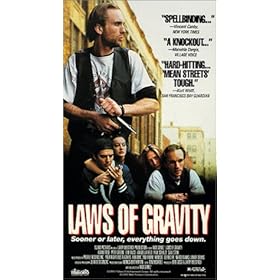
Recent Netflixing (Not Really 'Cuz I Own This on VHS Beeyotch!) - Laws of Gravity


"Mucka ferguson."

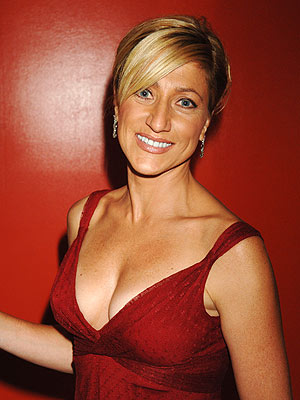
I don't even think it's out on DVD yet, and considering the budget and the quality of stock it's not really necessary (did I catch a boom in a shot?). I revisited this Brooklyn gem, from then first-time director Nick Gomez and featuring wonderful early performances from Edie Falco, Peter Greene (who I haven't seen in a WHILE) and Arabella Field (her first feature performance I think).


Adam Trese, who plays Jonny (similar to DeNiro's Johnny in Mean Streets, but in a more cutesy, baby-faced, modern version) has continued acting as well, but is also a successful real estate agent as well at Halstead! From his lips came one of the most ingenious non-profanity laced insults I've heard, which is why I started this post with it.


Gomez has since gone on to a very successful career as a TV director with shows like Brotherhood and earlier hits like Homicide: Life on the Street, after started off with 3 features (Laws of Gravity, New Jersey Drive, Illtown).


Whenever I see Edie Falco, I really take myself back always to this film. It was one of the first films I ever bought, on VHS, right after Reservoir Dogs and a couple of John Woo movies. I had never heard of it but I was intrigued as it seemed like a modern day Mean Streets.

What surprises me about the film, considering it was made 16 years ago now, is not only is it documentary and realistic in feel, but it's down to earth. The drama is not forced, and the dialogue consists of lots of subtle shifts and hints that never are told, always shown. At the same time, it's a very straightforward movie: Jimmy (Greene) and Jonny (Trese) and their respective ladies Denise and Celia (Falco and Field) are Brooklynites where the men don't work but steal and hustle, and the women work late at jobs that can't afford much more than some beers and a bed. One of the great quotes, as character actor Paul Schulze's (24, Sopranos) Frankie asks about cable, Jimmy goes, "Nah we don't have cable, this is Brooklyn". Another great moment is when Jimmy relights an almost fully smoked cigarette bud to grab a couple extra drags. There's such a great street sense in this film; even though the tough guys have beefs sometimes, they have no problem either expressing it violently while still coming in constant contact with each other because it's a community here.

Sal (Saul Stein) is the local loan shark/muscle and Frankie is back from Florida under shady circumstances to sell guns and evade questions about being a rat. Jonny's temper gets the best of him EVERY time. In the middle of it all, Jimmy owes people here and there and isn't quite peaceful, but overall is the moderator of the whole sh-bang. The film does a great job in grabbing a sense of desperation, the sense that there are not a lot of resources for these characters to live on. Everything is driven by the characters' tempers, and the movie ebbs and flows on that, not on any coincidences or contrivances. The camera roams verite style and never veers or strays too far, giving everything a claustrophobic, intimate feel. The style is classic and showed cinematographer Jean de Segonzac's potential as a lenser for Law & Order and other TV series as recent as New York's Gossip Girl. The daily hustles that the men go through are both necessary for them to exist but stem totally from an antisocial mindset. And the performances are really top notch.

Greene actually makes for an interesting leading man; a heel in The Usual Suspects, Pulp Fiction, and The Mask, among other films, he has a calming presence and when he rages, it's of a righteous quality. His soft spoken nature and sleepy eyes get you behind him as he moves and shakes through the little world they have going. Trese makes good use of all the blow ups and tantrums; his lazy mouthed stare belies the anger-at-any-moment nature of his character and is fun to watch.

Falco shows you that she's going to be a force in the material she works on later in her career; a natural sarcasm flows out of her and she's the voice of reason in all of this. Field's tragic character, getting stomped on by Jonny, yet coming back to him out of pure love but almost destructively confrontational, has an interesting vocal rhythm and it brings flavor to the role in a movie centered on the men.

Each scene tends to have its own situational banter and at the same time works toward the overall story. It's that kind of down to earth feel that makes this film a winner. There are no artsy shots; no time for that. The dialogue flys around (people talk at the same time, oh Altman) and it breathes and brims. Shot in 12 days for less than 40k, you couldn't ask for a better hour and a half.

The bar where they filmed at was the Ship's Mast Pub (link to NY Times article) on North 5th in Williamsburg, which was shut down not too long after they filmed; John Gallagher, the owner, plays Bobby the bartender in the film. The rest of the film was shot in Greenpoint; it's great to see the difference then and now, especially considering that Williamsburg has evolved into something completely different from the rest of Brooklyn and at the time was still like many now upscaling 'hoods like parts of Park Slope, etc. suffering from lots of crime and social unrest.

One note: Bill Sage has an extremely small part as a friend of a harrassed patron at the bar. Turns out he has gone on to a serious TV and film career with recent stints on the short lived Cashmere Mafia.

Laws of Gravity was nominated for 4 Independent Spirit Awards including Best First Feature, Best Actress, Best Actor, and Best Cinematography. Gomez won the Wolfgang Staudte Award at the Berlin Film Festival in 1993 for this as well.

I love this movie; if you really want to see some great footage of a bygone Brooklyn, check this out.

Laws of Gravity on IMDb

Monday, January 5, 2009

Notorious Trailer - Nobody Produces like Brooklyn Roots

Hopefully this'll be better than Get Rich or Die Tryin', because that was a bad movie from a great director (Jim Sheridan) and a great cinematographer (Declan Quinn). Notorious comes from director George Tillman, Jr., who previous did Men of Honor, which was well made but kind of underwhelming, and the '90s hit Soul Food. What's somewhat interesting is Reggie Bythewood, who co-wrote the film, whose credits include episodes of New York Undercover as well as Get On The Bus which was very engaging. However he did write Biker Boyz. Hmm....

I don't have high hopes, but I'd definitely like to see if I can spot some great location shots (a couple of buddies saw them filming in Crown Heights this past year). What would be great is to get a real slice of Brooklyn rap history; I think Get Rich didn't have an organic or natural feel as to how an artist develops out of a particularly New York upbringing. Getting a cast that includes Derek Luke and Anthony Mackie with Angela Bassett as B.I.G.'s mother, that's a start. The problem with a biopic like this is it can get simplified and sometimes there's no depth. As far as hip hop dramas go, it could be another Get Rich, or it could be an 8 Mile.


Notorious opens wide on January 16th, so if you are celebrating Martin Luther King, Jr., maybe take two hours to represent!

Saturday, October 18, 2008

Poster Critique: Up

Let's put Pixar in context; the consistency of their work I think puts them up there as one of the great, and productive, production houses ever. The high quality animation that they churn out, they pretty much have it all taken care of, 200+ million at the box office, a constant sense of wonder with each film, incredibly respected collaborators like Brad Bird, and unique stories that allow them to push themselves artistically and in the animation field. It's the Pixar brand, and when you get to that point, you allow yourself to be included in a great circle starting with the old studio system all the way to something like the Miramax during the 1990s.


In that sense there's really not much to critique about Up; all they really have to do is slap "Pixar" on it...oh wait they did. There you go, that's reason enough to see it. But they do it again with an adorable teaser poster that hopefully has been rolled out or will roll out soon, because I'll get to the theater super early just to look at it and get all warm and fuzzy before seeing possible crap. Such as Danny Deckchair, starring the wonderfully cute Miranda Otto, and from which I'm sure the creators of Up had to have noticed, both their poster for it and the idea behind balloon flight.

Sure, the great, blue sky is wonderful and not even that daunting due to the fact that the blue is exceptionally bright. There are so many subtle things about this poster though that really make it an interesting "small object in space" kind of thing. Let's start with the placing of the title; it looks like a cloud itself, massive because the scope of the picture looks to be massive. The tilt of the font and the addition of dimension as the top is bloated really is a great, suggestive piece to bring a lot of whimsy to the poster.

Obviously also, the fact that the house is drawn so tiny with SO many balloons is a fantastic idea that only seems like it could be from a fairy tale. It floats among the clouds, and even has the gentle shadow to show that it's even above the clouds. The use of the flying house is great too, there's a small sense of movement to the right, and it makes you wonder where it's going, and not only wonder, it makes you want to know what happens to this curious house flying around. Is the house flying on their own valition? Did they try a fun experiment? Or maybe that's the story; that the house flies around on purpose, checking out the world from a distinctly non house point of view. It also reminds me of Jack and the Beanstalk, a fun story in it's own right.

The clouds also don't take up the whole sheet, the ample separate from the massive title font and the clouds on the bottom half give buoancy, as if past the clouds there's something even cooler as the house flies right.

As always the bubbly use of color and a wonderfully neutral yellow for the house (reminds me of when they are trying to pick the shade of yellow in Juno).

You can check out Up at IMDB here.

Saturday, October 4, 2008

Poster Critique: Saw V

Now I can only admit that I've seen the first Saw movie, and I did think it was a solid movie, and Cary Elwes showed he can still carry a picture even nowadays. I did not think it was particularly great, for all it's devious decisions it put the characters through, it was actually less menacing than I thought coming in. I think Tobin Bell has been an incredibly good heavy over the years from C movies to television shows, he's got a great face, the beady, sleepy eyes have a tiring, alluring, and dangerous effect. It's good to see he has a franchise, and in general, it's actually kind of cool that a franchise can be built around a villian, but part of me feels like a lot of critics pan the series for not having any emotional strength.

I'll probably see Saw V, and catch up to it beforehand with the II, III, and IV, against the judgements of my friends. It is certainly one of the most successful horror franchises and the gore is always noted, as the premise revolves around a visceral obstacle or problem, which can be used to great effect in a story dramatically and visually.


So now we come to Saw V, out for Halloween as per the last four. I chose this poster over the man struggling with the box over his head because besides the tagline for that one: "You won't believe how it ends" I don't think there's much there.

It's to the point where they are able to build buzz by being seemingly elegant and suggestive with the title, leaving out "Saw" and just having the V, which is a strong letter besides being the numeral. The placement at the bottom also leaves the rest of the poster room for no clutter, and leaving out the credits also is a good touch. The Twisted Pictures and Lionsgate logo are less visible under a slight shadow and are mixed up in the arm hair, further leaving the viewer to concentrate on the profile. I really like the Saw artwork over the years and I particularly like this one for it's mystery.

Bell's face can be determined immediately due to the rugged but precise detail, so the viewer is thrown right back into his world, his perspective. He has become this towering figure in the franchise and the main reason why people go to see it; what kind of horrific tests can he think of next? His character, what is the next chapter in his own life? The use of his face as a mask with the messy Jason-ish straps is quite unnerving and very mysterious. The face is so detailed, and the eyes in place and the mask is alive. It presents the question of who is this man, and is he really him? Or is he someone else? Is there a purpose for his blank face, seemingly tired from four previous Saw movies? Or is it the calm before the storm?

All these questions pop up and that's a good thing; I'll want to know if I can figure out any more mysteries to this Jigsaw man, what exactly is there left to explore?

The color is just right, following suit from previous artwork, a kind of blotched, slightly desaturated and grimy tone. The man's hair is tossed, and the ample body hair kind of denotes some sort of beast. But the sedated expression and the mask pulled just so indicates a sort of harmlessness, an elegance almost that clashes with the high contrast background.

I also like how the light illuminates, somewhat harshly, the man's "face", but in essence it doesn't because you know it's just a mask. Everything, although within plain sight and done with great detail, it's just out of the reach of explanation. It's not simple. The fact that it's a profile versus some cheesy head-on shot is also a great advantage. The man may look like he is in a stupor, but again, it's just a mask, so what do we know? We'll have to find out.

Sunday, September 14, 2008

Recent Netflixing - Then She Found Me


Helen Hunt has been out of the spotlight for quite a while now after a brief few years as a interesting and grounded leading lady of films like Twister, As Good As It Gets (for which she won an Oscar), and What Women Want. Pay It Forward didn't really make a dent at the box office and after rooting for her especially when she won the Oscar, and thinking she could really have a fun career with staying power like Laura Linney or Laura Dern (although I now realize she doesn't have the range or fearlessness), I was kind of disappointed when I got wind that she really wanted to work on a pet project of hers. If you're Robert Duvall and you make The Apostle, it works. However, I feel like a lot of times when actors take on a directing role (Matt Dillon in City of Ghosts comes to mind for some reason) there can be less than stellar results, career-wise. It took a few years and didn't really get much fan fare despite the strong cast, but here she is with Then She Found Me, which was released earlier this month on DVD and Blu-ray.

(I'm taking on a review for this because it was filmed in Brooklyn (including St. Patrick's School, Coney Island, and way-out and very somberly filmed Gerritsen Beach, so I figured that's good enough for a lollygag or two).

If you have a picture of Hunt in What Women Want and compare it to any still from this movie, it's remarkable the difference. Her face is hollow and worn, the wrinkles on display as plainly as her wardrobe. She certainly is pulling no punches with her look, and the entire film is surprisingly coherent and somewhat unexciting, there's a natural feel to it that a lot of bigger indies I think really strive for and achieve a heightened sense of. To this teacher, April, who Hunt plays, life is a lot of pastels and grays.

April is shown getting married in the beginning at a Jewish ceremony to Matthew Broderick's character, Ben; they take off and do some bumper cars, but before you know it, her adoptive mother is sick and Ben feels let down by their probably boring life.

Enter two variables; one is a father of two kids who attend the school April teaches in, played with a weird intensity by Colin Firth, and the other is the appearance of April's birth mother in her life, played with an annoying intensity by Bette Midler. However, that annoying nature kind of works as you sense that Bernice, the birth mother/local talk show hostess, is a bit less than who she seems.

On top of all this, April struggles to grasp the concept of motherhood as she really wants a baby, but fears she is too old. Her brother, played by a very good actor Ben Shenkman, provides solace and a counterpoint to her feeling of not being as good because she was adopted.

So what does April do, and in turn, as the audience, how do we follow her small journey and come to see the film as a whole? It is strictly a character study; I wouldn't call it a comedy, I really wouldn't. Yes there are a couple of nice comedic moments, but they are placed carefully and I would really consider this much more of a drama. Hunt keeps it relatively simple in her first feature film as a director (with the exception of that very odd credit that she gives herself for writing the script; she's listed twice). In the commentary, which is "nice" but ultimately doesn't have quite the depth or entertainment value that I really demand to watch all the way through, she mentions that the whole movie revolves around the notion that in order to love and progress, you must come to accept betrayal. It is this theme that is most interesting to the film, and actually really carries it to the end. Much of the film teeters on being good but lacks a bit of punch with the camerawork. I think that was Hunt's intention, to not let the technical aspects get in the way, but it could have been a little more than pedestrian.

The other dimension is April's want of a natural born child. She struggles with her adoption still, and the entrance of Bernice, her birth mother, into her life just makes it more apparent at how lost she's felt. Firth's Frank has his own betrayal problems, his wife leaving him and his kids recently. I had a slight problem with Frank's intensity; he's an incredibly angry person, not tender at all really. He has a nice line, where he states that he's there for his kids until they can take care of themselves, and he doesn't have to like them. It's just his duty, and he makes that point to April in the midst of an argument stemming from a stupid but understandably impulsive decision midway through the film. Hunt's character is a good foil to his, but I just don't buy it, he's a bit too much.

Midler's character tempers down by the end, which is a good thing. April is nothing like her, and doesn't give her much room for mistake just because Bernice is her birth mother. That's something that is important, April's realization that even though her adoptive mother and her didn't get along too well, it was a real relationship and existed as such, and this leads to the last little twist of the film, which really leaves the movie on a high note.

Broderick is the lightest actor here probably in terms of what his character is able to get away with and the number of comedic moments he has. He does well as a child trapped in a man's body, although he's not really in it for that much.

Now to Hunt herself in the role of April. She actually does away with a lot of her particular mannerisms that have carried on throughout her career; she tends to accent sentences in a certain way, I feel like Bruce Willis and Tom Cruise especially are two actors who do that. She has a handful of moments where restraint is the key, because whatever makeup job they did, her sad eyes and tiny mouth in this film work wonders when the camera just sits on her as she's contemplating. She pulls out better beats in her dialogue than in previous films and it's one of her most patience performances. I think her character is a bit more reckless than she thinks, moving to decisions impulsively or at least seemingly so. One could argue that at that age, with less and less hope, she's just putting out her feelers and seeing what comes of it. The exchange between her and Firth at the end really is one of the best moments in the film, I wish the entire film could be as strong.

It's actually a bit pristine, and compared to another film about a Brooklyn teacher, Half Nelson, which granted has a much different tone and storyline, it suffers by comparison. Same can be said when comparing against Judy Berlin. These are all small films that deal with huge problems and have interesting relationships. But I think a film like Half Nelson is a bit more uncompromising and focused, and really presents a style that punctuates it's environment and while TSFM does that to an extent (Brooklyn does look like Brooklyn at least), the script hints at some great things but rarely hammers it home coherently; the structure is off due to the fact that there are a couple storylines going at once. The choices that end up being made are emotionally satisfying, but the themes are much richer, and I think that's what frustrated me about this film.

However, overall, I still thought it is a good effort and it's worth it to take a look. It's a bit boring for the first 30 or 40 minutes, but it starts to pick up, and the script gets stronger. Look for Salman Rushdie as a doctor and a few cameos on Bernice's talk show tapings. Maggie Siff from Mad Men also has a bit part.

I've heard it's much different from the book, and I think an interesting difference, according to Wikipedia, is that April didn't want a child in the book, whereas the film, for a purely emotional reason, April really wants a child (which kind of pushes a good chunk the plot).

Saturday, September 6, 2008

Poster Critique: The Express

One of my favorite posters of all time (I have 3 copies from my days at the old Latham Hoyts/Regal) was the Friday Night Lights poster where the 3 captains, holding hands, go out into the spotlight. It was gritty, it was dramatic, with a great sense of space, and a great anonymity to it, fuzzy, with three words: Hope Comes Alive.

Thus, with the latest critique we go to The Express, the latest inspirational sports story (do other countries really churn these out as much as we do?) to grace theaters this fall. Leatherheads didn't do very well, although that was a much different style; early fall has been kind to films like Invincible, provided that they have a great sense of period. Other recent films like Glory Road and Miracle stick to that true-story formula and deliver good numbers. It's football season, and everyone loves a good football tale.

And Dennis Quaid never hurts in feel good movies; he's been real good at it over the years. Rob Brown, who plays Ernie Davis in the film, also was in Finding Forrester, and this could be somewhat similar territory here.

So, onto the poster. Not my favorite, but when I'm browsing artwork for upcoming films, if something catches my eye just a little bit, I think it's definitely worth it to explore.

I like the sense of space that they are capturing, obviously placing Ernie in the foreground, in uniform, mid-stride creates a great sense of action. What makes it move is the cutoff; they trim his right side (probably could have trimmed more) and below his waist, and I think it gives it energy because it makes the character seem like he's one step ahead of everyone not only in the crowd but possible implied players behind him. His story was ahead of its time too, being the first black player to win the Heisman. I think it conveys that to a good extent. Since the poster really focuses on him literally (the background is a blur of outlines of the crowd and sideline) you get the feeling the film is going to portray a rather epic story but wants you to remember there's an intimacy with this character that they are inviting you to.

I also like that they put the bylines and copy (except the tagline) up at the top to balance the poster out; the overline on 'express' ushers a sense of speed, hence the title, and the title also features an outline of the Heisman, which was what Ernie was known most for.

To finish the poster off and give a great aged look, there's a bit of desaturation and I get the sense of sepia, combined with the era of his uniform definitely gives a nostalgic sheen. It feels down to earth, a period piece, Americana, and you know it's going to try to force the inspirational sugar down.

The tagline is ok; it could have had more to it, although if it's inspirational, that's adequate (if it were a controversial film, which I don't think it's going to be, they would have pushed the envelope farther). Also, the notion of changing things and progressing one yard at a time I think aims for an against all odds story, where every forward progress counts. And it also reminds me of Any Given Sunday, which has its flaws but that speech Pacino gives at the end in his usual delivery about fighting for every yard, every inch, always good for a real heart thumper.

The poster is of one man, but he is not among a crowd; he stands alone, and he is ahead of everyone else, that's what I get from the poster. It's a good title, not overdone like Invincible or Miracle or Glory Road, its his nickname, which brings an extra sense of individuality.

I just can't wait for a real Jackie Robinson biopic to come along. I also remember The Ernest Green Story, with a great young Morris Chestnut, I may have to watch that again, I thought that was pretty good.

here's the trailer: